Tuesday, January 6, 2026

Synchronizing climate events with our distant historical past. A fallen Pyramidion explains the North and South shafts found in the King's and Queen's chambers of the Great Pyramid

 ~Pharaoh Amenhemhat III Pyramidion text helps explain the unique Khufu shafts.  

~ The construction of the Great Pyramid precedes the collapses of  old Kingdoms throughout the world caused by a massive drought,  current consensus by climate studies suggesting a starting date  about 2200 BC.

~In this matter exact construction date of the great Pyramid is important, current consensus  dates 2580 to 2560 BC, Calibrated C14 samples tend to favour these dates, however a single star/sun shaft proposes construction begin and end  2370-2302 BC (the latter year implies finishing touches by Khufu's sons and grandson). 

Amenemhat III  pyramid


wikipedia

 was once crowned with black capstone pyramidion fortunately with text, 


     Wikipedia ,East side of Amenemhat III pyramidion

     https://www.youtube.com/watch?v=0g_V2A2NEE4  Great translation!

The North Side text is of astronomical interest:

   "Higher is the Ba of the King of upper and Lower Egypt Nimaatre  then the height of Orion as it joins the Duat Ra-Horakthy, he makes firm the son of Ra of his body Amenemhat, who is in the midst of the northern starry sky"

   Nimaatre is the crown name for Amenemhat III.  The North side  text explicitly joins the sun God RA with Orion, Osiris or  Amenemhat through the Duat, a door, which in my opinion can be a shaft towards the sky. These words imply the joining of the souls between RA and the living son of Osiris., which happens during the coronation, anointed by sun rays by day being at the same level as an Orion star by night . 

   The South side shaft of the Great Pyramid  Kings chamber, the one with the coffin, was also pointed towards Orion,  The South shaft, more straight, towards our sun (RA), was (still is) illuminating the shaft at the start of the growing season.   Amenemhat pyramidion text, at the top of the finished pyramid, was directed to the Gods, not the general population.  Unfortunately,  his pyramid was built 570 years or so after the Great Pyramid.  The Southern pyramidion text has no celestial descriptions.  But there is a hint,  a description of a secret ceremony:

         "He who is upon his mountain and behind the king of Upper and Lower Egypt the Lord of doing Nimaatre, united with the Western desert inside the great shrine, the lord of good offering who is in it and given it his inheritance the lord of eternity and everlasting" 

     This is in large part a description of a coronation ritual inside a great shrine,  ascending the pharaoh to be an eternal being, to be a god.  By this description, he was likely seated on his not quite completed "mountain" pyramid with his earthly father behind or beside him, indeed, there was a co-regency with his father Pharaoh Senusret III (Kakhaure) lasting 20 years. 

        The said Queen's chamber of the Great Pyramid was the coronation room of Khufu, the South shaft was precisely aligned to Sirius, the star representing Isis the bride of Osiris. The coronation day was when Isis and RA where at the same altitude shining through this shaft.  From this ritual, an exact date of construction can be greatly narrowed. For this reason, if Khufu reigned for more than 30 years, his 2nd coronation day, called hb sb, could have been close to November 19 2340 BC.  

More work need be done about this.

The following are preceding must read articles:

https://eh2r.blogspot.com/2024/05/introducing-optical-ancient-chronology.html

https://eh2r.blogspot.com/2023/04/astro-dating-ancient-egyptian-ra.html

https://eh2r.blogspot.com/2023/04/astro-dating-ancient-egyptian-ra.html

The above elucidate that there can potentially be many ancient structures or Megaliths which can be backdated, even if the temples or structures have been demolished or damaged,  ancient structures horizons almost never changed compared to human constructions.  WD January 6 2026


Monday, January 5, 2026

From thin to thinner, and the new January Arctic Ocean sea ice look

 ~Nothing is stopping the great Arctic Ocean sea ice transformations

~One photo is like taken from another Polar planet


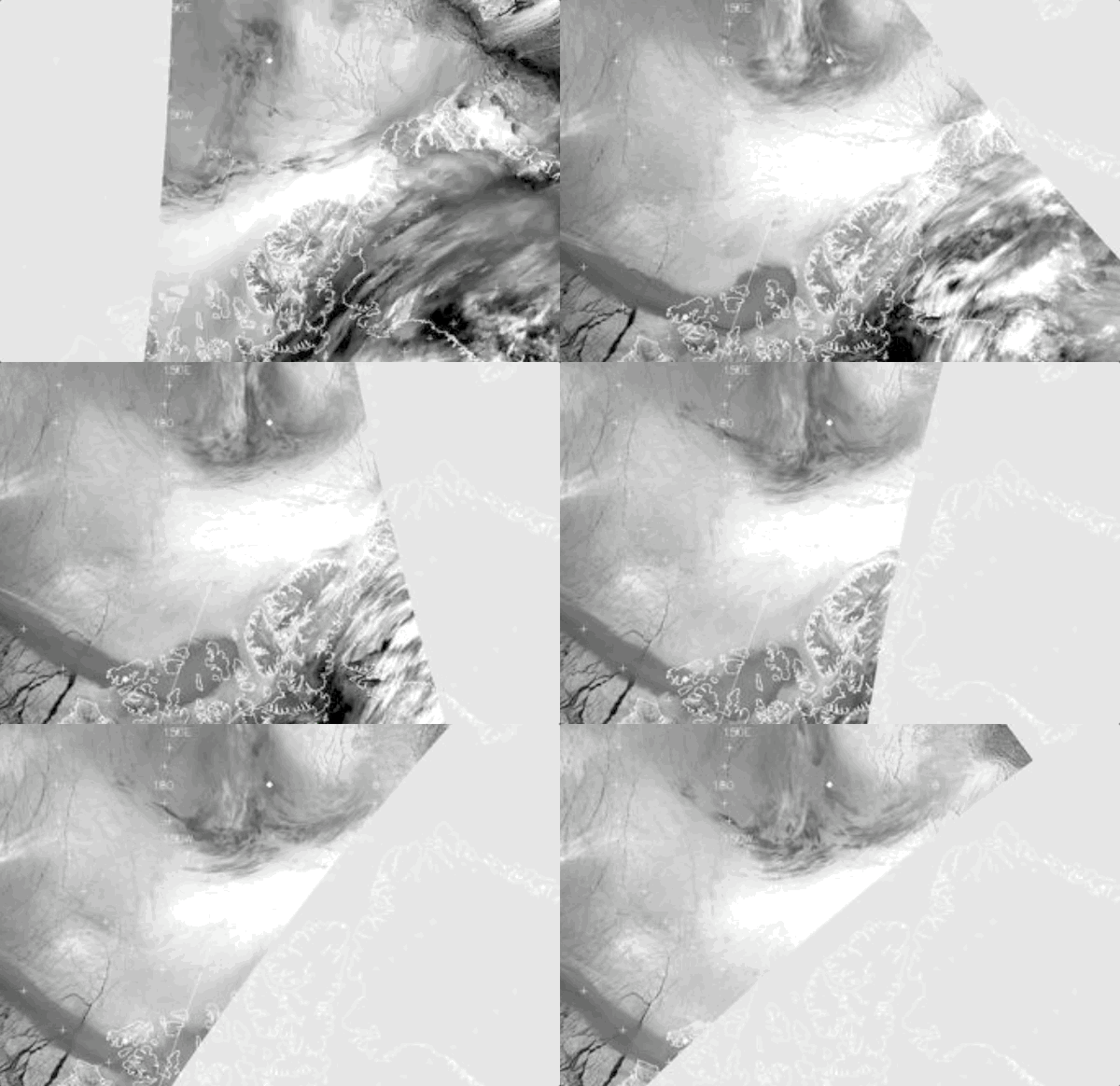
The first shot in this loop, is Near North Pole 180 degree meridian January 5 2026 RADARSAT sar image.  It looks like the ice has had a great extent minimum.  The next 2 are North of Greenland, they look like the sea ice is moving fast leaving wide open water leads.  The 4th shot appears like from out of this world, North of Franz Josef  Island,  likely very thin ice with hardly any snow on it.  The 4th is your viewing anchor, it has a white streak at 60 degree angle.  2025 minimum extent was 10th place tied with 2008 and 2010. But I don't recall January 2009 and 2010 sea ice looking like this at all, they had more snow and less leads.  The pictorial difference suggests much thinner ice in 2026.  Sea ice extent numbers may be misleading,  the warming did not stop, rather the great North Pacific sea surface temperature heat blob dominated and dominates again, literally cancelling out what deep cooling a

La Nina can do (usually favouring more accretion in winter).   NOAA sea surface temperature, the more of the same, except,  La-Nina should have triggered a massive cooling during the long Arctic night.  Instead North Baffin and environs have had rain, in the High Arctic.  Such is fruition of the warming predicted in the 1980's and the new look is unsettling even though it was expected. WD January 5, 2026

Friday, June 13, 2025

Arctic Basin pressure system switchover, on schedule

~A helpful defence against complete meltdown of all Arctic sea ice


   Arctic Ocean pressure system summer switchover occurs when Arctic cyclones persist over colder areas, as opposed to winter hugging over warmer sources, such as open sea water.  It is a phenomenal counter melting action, which saves sea ice extinction.   It turns out to be also,  a bearer of more Arctic rains on the Canadian  Arctic archipelago, furthering the detriment of permafrost,  which when warmed furthers the presence of Anticyclones which persist over warm sources in Arctic summers.    The reverse 
scenario, may happen,  such as during summer 2007, when a High Pressure system persisted over the Arctic Ocean gyre area, exacerbating the sea ice melting a great deal, even of very thick sea ice, this was likely a dynamic pressure blocking scenario, or just as much from an extreme heat wave over Arctic lands spilling over to sea,  which invites the presence of a steady High pressure system 

   CMC surface analysis, June 13 2025 00 UTC.  A Gyre Low, counters the normal Gyre clockwise current, which was powered by many winter months of a steady High pressure system.  It is characterized by colder temperatures,  likely sustained by clouds, which are a plenty when warm moist air streams over colder sea ice. The clouds and sea ice maintain a colder surface than adjoining areas bombarded with sun rays to the surface. I see the Great North Pacific warm temperature blob as the main source of moisture sustaining this balance of clouds.   Of Course, the North Atlantic , equally warmer, is another source. 

Referring to beginning of May projection from this website:


https://eh2r.blogspot.com/2025/05/2025-late-spring-summer-and-early-fall.html


   The rain onslaught is starting, only an extreme heat wave can break this from happening. WD June 13, 2025.


Tuesday, May 20, 2025

ENSO shift? Not seeing accostumed sea surface temperature platform chart, puts single station forecasting/projections to the test

 ~Not reading fresh NOAA sst maps makes ENSO forecasting harder


       Ground hog April 7 day, not renewed NOAA SST chart,  with a stuck in the past one day display, at least suggested then, a return to El-Nino.  There has been no daily production since.  Kind of removing an important forecasting tool.  

  Luckily, U of Maine reanalyzer posits otherwise.:

A reversal?  At least it reads so here, but everything is blurred again, the North Pacific strong sea temperature mega blob nesses ENDO predictions a great deal, especially from an Arctic point of viewing.  


May 19 2025 Massive Arctic cloudiness, multi layered, long lasting,  would, according to  ENSO cloud seeding theory,  suggest a return of El-Nino.  But it appears that the great North Pacific sea surface heat  blob,  much more so than  Atlantic influence let alone ENSO gyrations, will once again save the Arctic Ocean sea ice from total obliteration. 

The MIMIC look is astounding, wave after wave of Northward moisture, likely to continue all summer,  ensures little chance for a 2207 like July mega melt.  Indeed to  be enforcing, as projected, a quasi permanent Low pressure sitting a top the Arctic Ocean basin Gyre area.

    Likely spared summer sea ice does not mean recovery,  the Arctic sea ice Maximum is shrinking every spring, the ice is equally thinning every melt season as well.      WD May 20, 2025


Sunday, May 4, 2025

2025 late spring summer and early fall weather projection, a lot influenced by refraction data

 ~Still after 21 years,  unorthodox

~There was a shift with previous 2 years, potential reason: it snowed more over the Arctic Ocean

  I am a bit late this year because of equipment malfunctions, with only 150 sun disk measurements,  I could only partially surmised the evidence with previous years, what it showed was the return of the spring CTNP, Cold Temperature North Pole,  over the Canadian Arctic Archipelago.    Which would have meant a break with last year more expanded sun disks, however it is complicated,  late winter very early spring sunsets were much more roundish, onto itself describing very important warming.  As said over the years, a sun disk measurement is an extremely accurate description of the temperature of the entire atmosphere. Arctic surface  touching lower sun limbs come often distorted,  it becomes not only a temperature of the entire atmosphere, but rather a very accurate description of the extreme lower atmosphere. It often looks like a spectrum with lines of the interface between air and:  ice, land or sea water.  Visualizing rounder sunsets is an important observation, it implies a significant warming over a very broad swat of the atmosphere.   March and April 2025 was much warmer than usual, with often days 10 C above normal.   This variation unto self, has caused some sunsets to be later, but most were lame in tardiness.  

   Sea ice was again thin,  some 50 to 80 cm thinner than the not so distant past.  It could have been even thinner, was it not for lack of snow cover and the strong wind storms being more common.  Thin sea ice combined with spring sun rays effectively start the sea ice melting season,  which was the earliest on record, as judged optically by the phenomenon called "first melt".  That is when the Astronomical Horizon is regained. When so ice at the bottom of sea ice looses accretion because the sun warmed up the top part enough this happens in the afternoon, for longer and longer time as the sun ascends further.   First melt has two basic components, the first sighting and subsequent  distinct period of when it occurs regularly every day,  the former was March 25,  the latter was very early April onwards. This is an indication that sea ice will melt earlier than expected likely throughout the Arctic. 


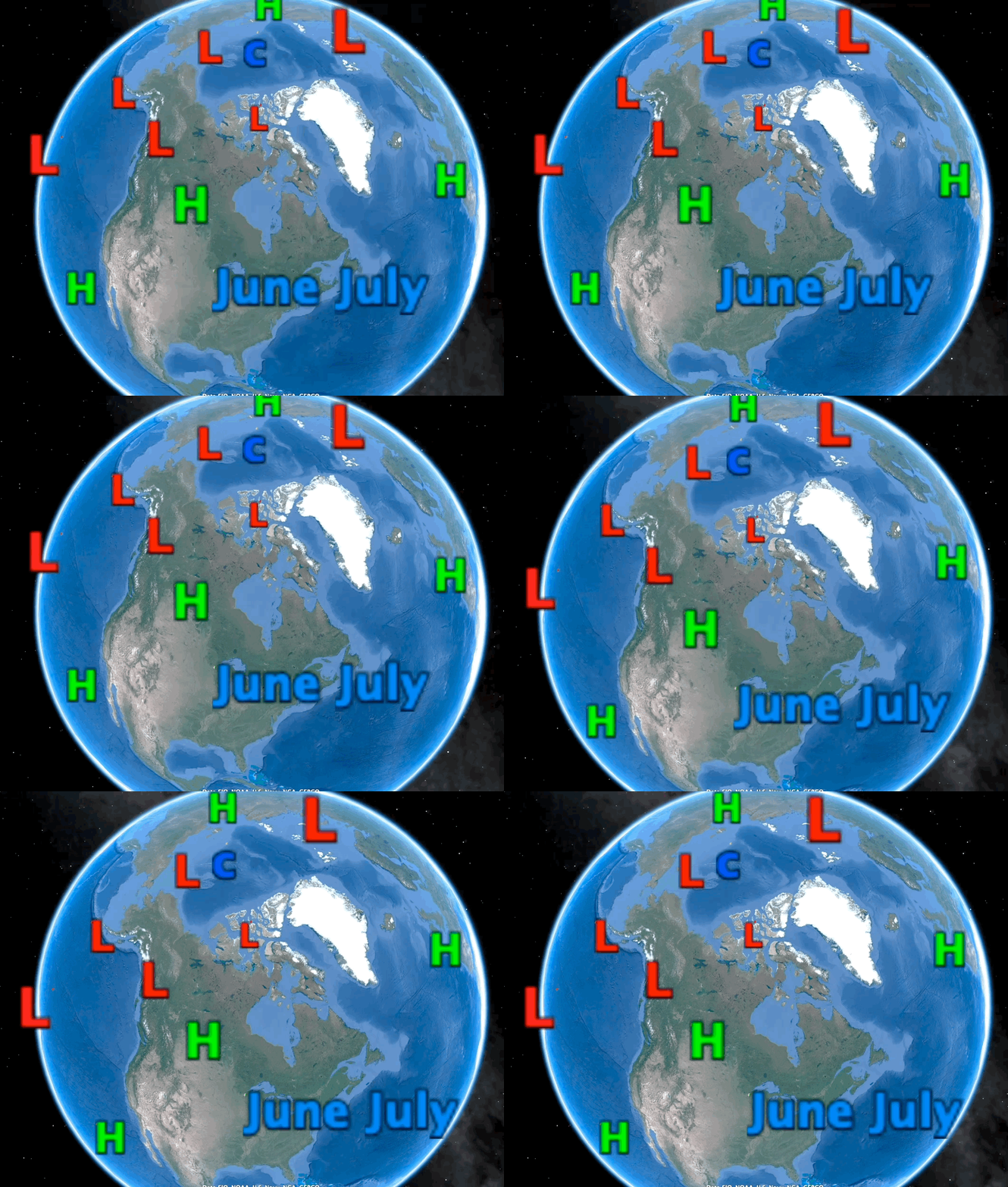
   May 2025 projection.  A strong presence of the Cold Temperature North Pole,  even in a  warmed world,  there will always be one.  C marks the spot the smaller c is the secondary just North of Eurasia. A high pressure should dominate the Arctic Ocean basin area,  until early June, the fading jet stream in yellow will collapse at a likewise time. A slowly moving Northwards High pressure will dominate the Canadian American boarder area at about Saskatchewan.  North Pacific and Atlantic Highs will substantially add heat to the already warmed oceans.  Gulf of Mexico moisture carried by cyclones will also be a common feature all the way to Newfoundland.   

     A smaller CTNP should lodge just off the North Pole on the Russian side.  The ever so present Arctic Ocean High pressure Gyre will switch to a near permanent cyclone  mid June, because of apparently extra  thicker snow cover,  which should transform in ice ravaging melt ponds, but the cylone clouds will be easing the sea ice melt from being extreme. Extra cloud feature alone slows the coming of a catastrophic total sea ice melt event.  Warmer Ocean in origin  clouds reflect sunlight otherwise destined to melt everything.  But the much warmer Oceans will one year overtake the benefits they give.  Main summer Archipelago feature will be the rains mainly fuelled by the much warmed North  Atlantic and Pacific.  The Polar jet stream will vanish early June  leaving Northern Hemisphere circulations to languish slowly or stop for days.   Again High pressures will dominate Central North America bringing even more warming to the Arctic.  Absent Polar jet stream with much warmed sub-Arctic will extend the number of days with heat waves everywhere.
   The white line over Arctic ocean is sea ice extent at minima. I expect a massive melt despite extensive Arctic clouds.  Year by year sea ice is thinning, despite expansive cloud albedo reflections, that is because Maximum is not sparred from warmer winter during the long night, sea ice in March was measured to be all time lowest in history.    Hurricanes should languish going nowhere or hug the coast of Gulf of Mexico and East Atlantic, not driven fast but stirred by synoptic weather .  Early autumn break from the rain awaits much of the Arctic.

    Not having a full slate of sun disk observations makes an ENSO prediction difficult,  usually sun disk diameter expansions have been linked with a surging El-Nino conversely more numerous than usual sun disk measurements were directly linked with La-Nina.   However, I can interpolate,  there was a lot of clear days until about beginning of April, suggesting either end of La-Nina or surging one.  whether of the 2 was answered in Cloudy April, La-Nina unlikely.   I have only one tool left from the sky which helps determine El-Nino,  and there was numerous extreme high clouds, beyond 25K laser range. Presence of  these gave a strong affiliation with El-Nino, so there is a likely coming El-Nino, if so good for sea ice given the extra clouds will spare extra melting. Despite all this, Arctic sea ice extent at Minima should be slightly lesser than 2012. WD May 4 2025

Sunday, April 27, 2025

Roller Coaster clouds, mechanism confirmed by rapidly varying in direction winds and sudden refraction readings change

 ~Low clouds shaped by North to Northeast taking turns with Northwest winds,  natural art with interesting science.

~They implicate co-existing micro to macro dynamic structures, a rather much more complex meteorology, stubbornly mostly invisible. 

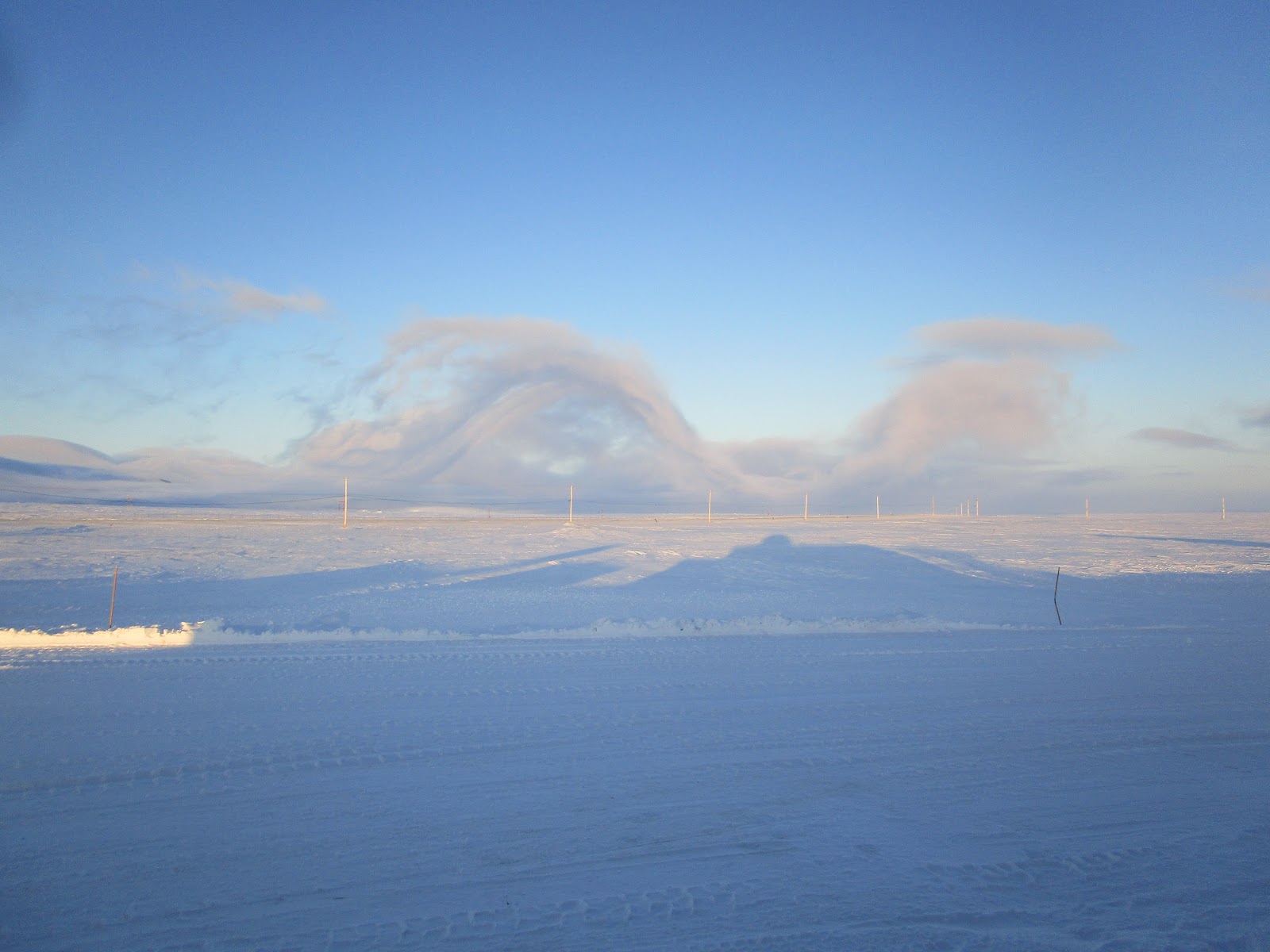
     The wavy nature of these just prior straight clouds, well away of a hill, are Roller Coaster clouds,  straight away from the camera lens is the Northwest, 90 degrees right Northeast winds cause the clouds to descend . You can note on the second wave, the up and down curve  mimics a coaster.  It turns out that the sky refraction varied when one wind direction dominated versus the other.  

20:00-15.8-18.381LegendMM3517 101.38 -24LegendNANA
21:00-16.8-20.176LegendMM134 101.31 -29LegendNANA
22:00-18.3-21.278LegendMM3221 101.31 -29LegendNANA
23:00-18.8-21.778LegendMM3527 101.24 -30LegendNANA

Southwest Cornwallis Island consist of a raised beach descending to Barrow and McDougall Sound,  it has a  200 to 300 meter raised plateau a few Kilometres Eastwards from shore.  Hourly winds of record on April 25 also miss the Northeast gusts which happened late in the Evening (6th column is wind direction, 7th is speed in Km/hr.). 


The camera is aimed towards the Southeast, again occasional winds from the North or Northeast, in irregular sequence with winds from the Northwest created these spectacular Roller Coaster clouds, 200 meters or so high, touching the ground at about 40 meters.  

      At the same time of these I measured sun disks varying in dimensions confirming the mixed nature of the air, one was colder the other over all warmer.  This well defined cloud geometry is again the first time witnessed or filmed by me, this was a very rare event.  Surely something like this occurred in the past with only lenticular clouds far from touching the surface.  The refraction bit is quite exciting, it is not unusual to measure wild variations in sun disk dimensions, these are still a great puzzle,  because invisible air does not define. However, variable refraction moments indicate unknown un mapped air pockets,  some quite large and lasting, some fleeting and small.    This definitely indicates a rather complex atmosphere abounds all around us, sort of a field of Lorenz mega butterflies, may trigger, detour, reshape, stall or accelerate ongoing patterns.  This complexity may be known by some carefully looking at surface weather maps, showings mysterious small Lows or anticyclones, rather captured by satellite pictures and positioned on a weather chart.  There can be an abundance of small vortices, or on some days, none.  These are what makes weather difficult to predict,  they also can be uncovered, but no one is actually seeing or mapping them enough, EH2r introduces the beginning  tip of a discovery iceberg  perhaps leading to a radical different weather map never imagined, surely to be achieved, on a  future perfect good forecast spanning much longer than a few days. WD April 27 2025  


Sunday, April 6, 2025

Leads everywhere! State of Arctic sea ice after Maximum extent 2025

~Again  never seen before, new Spring time Arctic Ocean  icescape

    April 20 1988 NOAA infrared satellite , Arctic Ocean surface ice looks bland, very cold,  nothing very much to report about, leads were found with difficulty, yet the setting for this picture had an extra effort application to find them.  Look at Smith Sound, the reverse V polynya in black, North of Baffin Bay, between Greenland and Canada.  There is some warm sea ice just to its South in faint grey. If there was any open water leads about the North Pole, they would have appeared in black. By the way, Smith Sound polynya feature is a complex creation of ocean currents, but in particular Kennedy Strait (North of the inverse pointed V) being solidly frozen, this allows many non migrating species to survive the winter, with more spacious open sea water.

Same picture, this time set to really look for the leads about the North Pole, there are many covering the Arctic Ocean, but these are old, likely some are multiyear old,  frozen over and thick.  The photo was enhanced to highlight dark colours, so much so that the IR temperature setting basically shaded land areas black, these were warmer further South, except for of course Greenland. 


Flash forward April 3 2025, NOAA IR HRPT Photo:


     Leads everywhere  you look about the Arctic Ocean having warmer sea ice surface,  Smith Sound Polynya deformed, viewed from space the planet appears to have  obviously warmed,  remember this photo is taken 2 weeks earlier than the 1988 one.

  The photo clearly demonstrates a sorry state of sea, deteriorated in a mere 37 years.  WD April 6, 2025


Thursday, March 13, 2025

Very bright twilight or possible sunrise beginning of long day at the North Pole, 8 days before March 21

 ~Atmospheric refraction bends Earth's Terminator

~ Likely enough to cause a sunrise after long night. 


   March 13 2025 NOAA Satellite HRPT Visual Loop, shows the Terminator line, that is the border between night and day as the Earth rotates, here is a North Pole view. The terminator line is not straight, reflecting the varying atmospheric refraction properties which also depends on sea ice thickness. 2025 sea is likely at all time thinnest levels,  a very thick icescape would easily bring out a North Pole  sun on March 13,  however a very cold surface air just below much warmer air would do the same even with thinner sea ice. So it is a matter of being there at the North Pole to confirm this.   In this example, there was a stagnant pool of cold air spanning from Greenland to the Pole. This was enough to bend the terminator at the Pole,  therefore  a strong possibility that the sun line is present. 


     Same loop NOAA HRPT infrared.  Just North of Ellesmere Island is almost to North Pole "white zone", seasonal cold air,  being mixed with approaching cyclones from the North and the South.  This cold gives an imprint on the ice,  certainly capable of changing the horizon significantly especially after a sudden warming. 

 On a certain March 13 in the late 1980's a very capable de Havilland  pilot named Russell, flew near the Pole to confirm that it was bright enough to land a plane there.  There was enough contrast resolution to land an aircraft on natural sea ice while refraction surfing the light rays beyond earths shadow.WD March 13 2025

Monday, February 17, 2025

Big Lead no more straight, follows the coasline instead.

 ~A continuation of never seen before events


Radarsat NW Canadian Archipelago February 17,  The big lead just shows up, wuite remarkably clearly. 


NOAA HRPT loop same day, this time it is a wind driven opening, at winter's potentially coldest time.  In the not so distant past, this was a May event. On coldest  winter the big lead  also appeared more straight alongside the Canadian Arctic Archipelago NW shoreline.  WD February 17, 2025

Friday, January 31, 2025

Potomac crash flight paths, and background refraction


 -Actively looking for refraction effects, especially from street  lights, inconclusive from yet good video evidence.  The flight paths of both aircraft was captured pretty well, because of fixed mount of camera. The jet was descending slowly, while the helicopter appears to have changed altitude directions twice.

taken from:

https://www.youtube.com/watch?v=ZUI-ZJwXnZ4

the fix frame camera is very helpful, especially in detecting mirages, which did cause aircraft accidents on occasions in the past.  RIP to those lost, and condolence to families...WD January 31 2025.